

Women and Long-Term Care Planning
Why is long term care a double-edged sword for women? They are often the primary caregivers for a loved one, and they account for 2/3 of all long term care claims. Learn why women need to plan for their own extended care needs, and find the tools to help you enable these conversations,
Share these messages using our March Marketing Tools!

Two key reasons to discuss her long term care concerns
Women understand consequences and often drive the sale
When you facilitate a woman into leading the discussion, she is less likely to be put into a position of contradicting her partner and may be more forthcoming with her feelings. Once the spouse hears her legitimate concerns about the consequences of not planning ahead — the tone has been set to address and avoid potential consequences that could impact their entire family, and putting a plan in place is more likely to happen.
Women buy long term care, men buy returns
Advisors sometimes make the mistake of showing one solution to a couple, then wonder why they only get one party (or neither) to purchase LTC coverage. As it turns out, 82% of people buying traditional LTCi policies are married, yet twice as many of these type policies are sold to women . People buy what looks and feels good to them – and provides a sense that their need is met. Long term care is not at the top of the list with many clients (especially men), so the solution you offer should meet an underlying need or concern. That may mean showing different solutions to each party of the couple
Connecting with her concerns
- Have you ever provided care to an aging loved one? What impact did that experience have on you? How did you feel physically? Emotionally? What were the consequences for your own family and lifestyle? How would you feel if your own children were put in a similar position?
- Women live an average of five years longer than men, meaning she may not have a partner to care for her in her time of need. Women currently account for 2/3 of all long term care claims, and are found to be on claim for 50% longer than men. For these reasons, women pay more for long term care insurance than men.
- An extended care plan allows you to continue caring for your family even when you are the one actually needing assistance. With the proper resources and funding, your loved ones can manage your care while minimizing the consequences on their own lives.
- Caregiving doesn’t always bring families together, in fact it may tear some families apart.
- If you needed care, would you want to receive it in the comfort of your own home? Where children and grandchildren may be able to easily visit? If so, what is your plan to remain independent?
- The cost of balancing work with caregiving costs the average woman around $324,000 over her lifetime due to lost wages, social security and pension benefits.

CLTC Article: LTC and the Double-Edged Sword for Women
There’s a great article for producers on women and extended care in CLTC Digest.
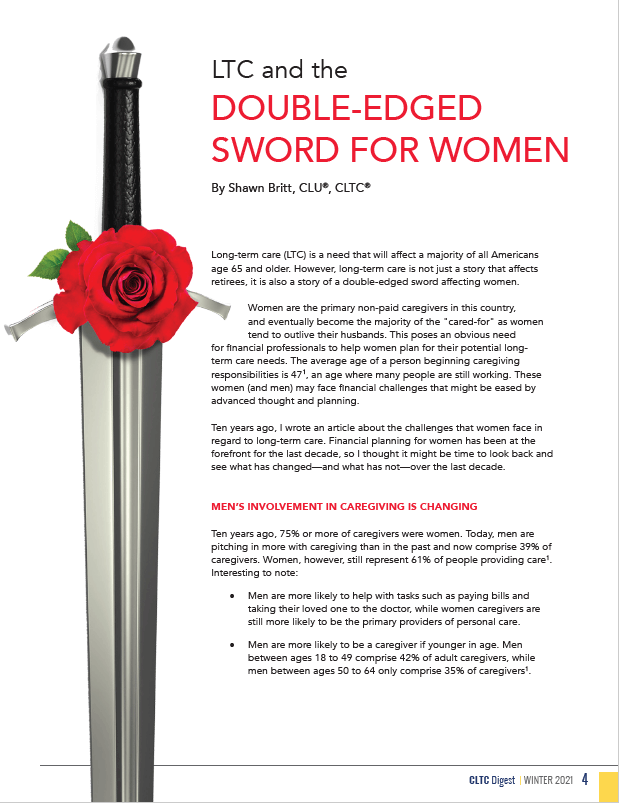
For more great content like this, subscribe to CLTC Digest. It’s a quarterly publication offering industry insights, expert perspectives and news for those in the long term care insurance business. Click here to learn more.
Better yet, earn your CLTC Designation. Click here to learn more.


Lincoln Financial has created several great pieces on women and LTC. Click here to access the items below (and more).
- Caregiving Women Infographic — Client
- Women and Long-Term Care – Client White Paper
- Women & LTC – Client Seminar
- Women & LTC – Financial Professional Seminar